 Skip to content
World of Tanks has leaned hard into event premium tanks—vehicles wrapped in major branding, limited-time availability, and elevated expectations. Once the marketing cycle ends, however, players are left with a simple question: how does the tank actually perform in everyday matchmaking?
The OCP Peacekeeper answers that question in a way many players didn’t expect.
Delivered as part of the January RoboCop Battle Pass Special, OCP Peacekeeper is positioned as more than “just another Tier IX premium.” On paper, it checks all the right boxes for a comfortable heavy: 440 alpha damage, 258 mm penetration, −10° gun depression, and a turret armor profile that reads like a warning label at 330 mm. Those numbers suggest reliability, confidence, and forgiving gameplay. In real battles, the experience is far more demanding.
This article treats OCP Peacekeeper as a functional battlefield tool, not a collector’s display piece. The stats are examined through real gameplay outcomes—what they enable, where they quietly fail, and why player opinion divided almost immediately after release, despite the RoboCop theme and Battle Pass framing.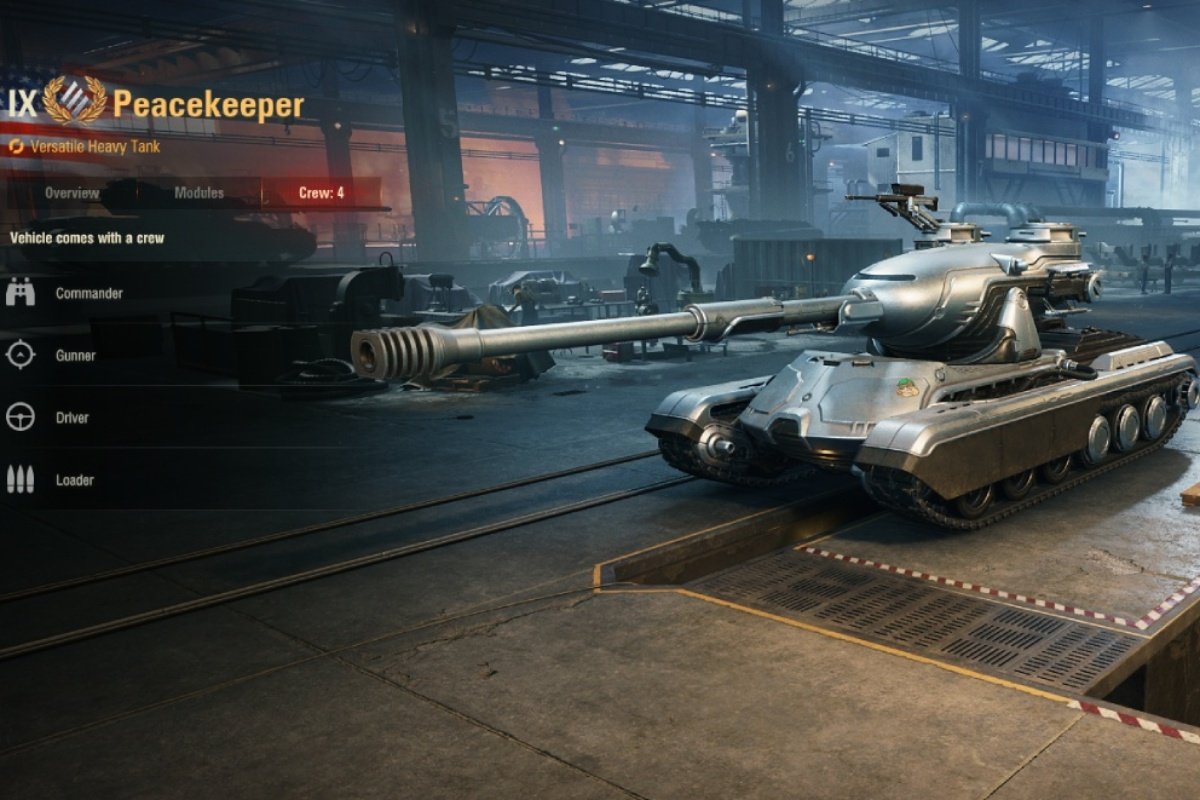
TL;DR: OCP Peacekeeper in 60 seconds
- Best role: A lane anchor that slows the match down, not a damage-chasing brawler
- Gun behavior: Consistent when fully aimed; rushed peeks make the accuracy feel worse than advertised
- Armor reality: Turret-forward survivability works—until opponents exploit weak points and predictable ridge play
- Mobility cost: 40 km/h is fine early, but late-game repositioning is expensive
- Overall value: Strong for collectors and methodical heavy players; unconvincing as a must-have competitive premium
OCP Peacekeeper Stats – Tier IX U.S. Heavy Tank
| Category | Characteristic | Value |
|---|---|---|
| Firepower | Average Damage | 440 HP |
| Average Penetration | 258 mm | |
| Rate of Fire | 5.22 rounds/min | |
| Gun Reloading Time | 11.51 s | |
| Gun Traverse Speed | 39.63 deg/s | |
| Gun Depression / Elevation | −10° / +20° | |
| Aiming Time | 2.21 s | |
| Dispersion at 100 m | 0.38 m | |
| Average Damage per Minute | 2,295 HP/min | |
| Survivability | Hit Points | 1,900 HP |
| Hull Armor | 165 / 89 / 38 mm | |
| Turret Armor | 330 / 102 / 51 mm | |
| Suspension Repair Time | 12.03 / 9.29 s | |
| Mobility | Weight | 46.58 t |
| Engine Power | 740 hp | |
| Specific Power | 15.89 hp/t | |
| Top Speed / Reverse Speed | 40 / 17 km/h | |
| Traverse Speed | 29.2 deg/s | |
| Concealment | Stationary Vehicle | 4.56% / 0.82% |
| Moving Vehicle | 2.28% / 0.41% | |
| Spotting | View Range | 390 m |
| Signal Range | 670 m |
What OCP Peacekeeper Really Is
OCP Peacekeeper is a Tier IX U.S. premium heavy built on a familiar foundation. Its handling, layout, and mechanics place it very close to the M-VI-Y (120) tech-tree platform, with several tuning differences rather than a fundamentally new identity. That similarity is central to both its strengths and its problems.
The key question isn’t whether the tank looks good—it does. The real question is whether it justifies completing the RoboCop Battle Pass and paying roughly 3,500 gold for the premium track unlock.
That question sparked the immediate “clone versus value” debate. Event premiums are expected to smooth out frustrations, not amplify them. Peacekeeper does the opposite: it rewards discipline and punishes impatience, sometimes more harshly than players expect from a paid Battle Pass reward.
OCP Peacekeeper Gun and firepower
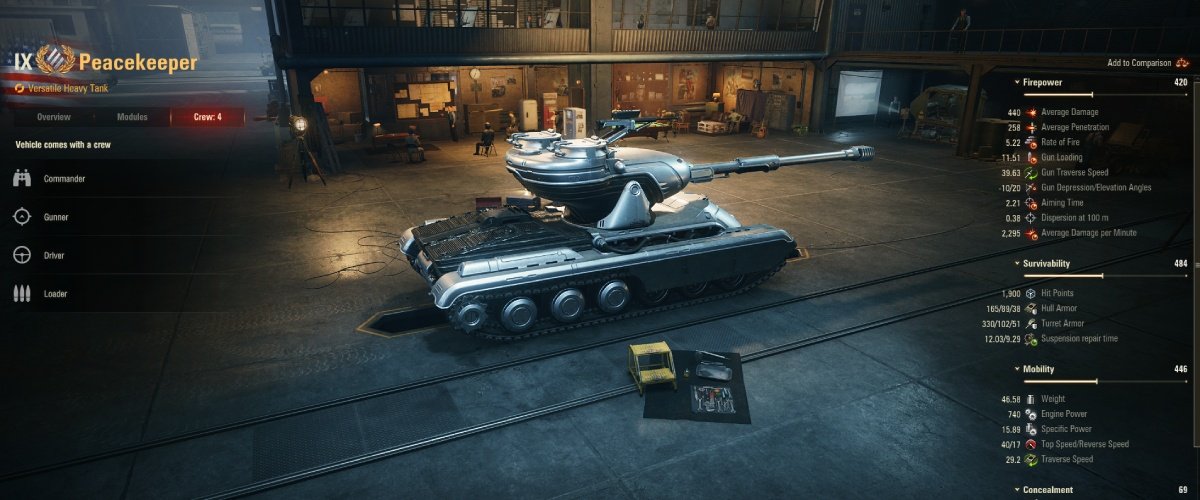
The gun is the tank’s headline feature. 440 alpha damage is meaningful at Tier IX and makes individual trades matter. However, Peacekeeper does not convert that alpha into effortless damage. Its output depends heavily on shot quality, timing, and positioning rather than sustained pressure.
Ammunition Behavior: Fast Shells, Real Trade-Offs
Peacekeeper uses APCR as standard ammunition, which provides excellent shell velocity and makes mid-range shots feel responsive. The trade-off is familiar to experienced players: APCR is less forgiving against angled armor than AP. As a result, the apparent penetration advantage does not automatically translate into easier damage when opponents angle correctly.
Premium ammunition is available—commonly referenced at 310 mm HEAT—but it does not function as a universal solution. It is effective when used deliberately, yet still requires proper target selection and angle management. Poor pushes are punished regardless of shell choice.
HE: Tempting on Paper, Inefficient in Practice
Despite unusually high HE penetration for a heavy tank, the actual damage increase is modest. The result is a classic trap: HE looks useful but rarely improves outcomes enough to justify consistent use. In most situations, APCR remains the most reliable option.
Ammo Capacity: A Subtle but Real Limitation
Peacekeeper carries fewer shells than several comparable event heavies. This becomes noticeable in longer matches, defensive holds, blind-firing scenarios, or repeated cap resets. It’s not a balance flaw—but it reinforces the tank’s pattern of punishing inefficiency.
Gun Handling and Mobility: Precision Required
Gun handling is mixed. The aim time is competitive, but overall accuracy and movement dispersion are less forgiving. An important nuance defines the tank’s feel:
- Turret rotation snapshots can work surprisingly well
- Firing while moving the hull is inconsistent and often unreliable
This pushes Peacekeeper into a strict rhythm: peek → settle → fire → disengage. When that rhythm is respected, the tank feels stable. When it’s broken, the gun quickly feels worse than its stats suggest. Mobility is serviceable for Tier IX. The tank can reach early ridges and key corridors, but it is not built for late-game improvisation. Once committed to a flank, repositioning comes at a cost.
Armor and survivability: the turret sells confidence, then demands micromanagement
Peacekeeper’s hull armor is described as average at best: workable against lower tiers, unreliable against anything serious. The lower plate is framed as a consistent liability, and that alone is enough to kill the “brain-off brawler” fantasy.
At 330 mm frontal armor, the turret looks formidable. Combined with −10° gun depression, it clearly encourages hull-down play. The issue is geometry. Large, permanently exposed weak points remain visible even at full depression. Attempts to cover them by raising the gun simply expose other vulnerable areas.
As a result, defense shifts from controlled armor usage to constant micromanagement—wiggling, gun elevation adjustments, and unpredictability. At Tier IX, where opponents can aim, that is an unstable long-term strategy.
Reserve track mechanic: useful, but mostly in the unglamorous way
Peacekeeper also uses the reserve track mechanic associated with the Yoh-style heavies. It can help the tank keep moving briefly after a track is broken. In real battles, it’s described as situational: it often matters more as a way to save repair kits and avoid being perma-tracked than as a tool that enables aggressive plays. It helps you not lose for free; it doesn’t help you win for free.
Gameplay experience: strong theme, polished presentation, and a frustrating loop
Peacekeeper performs best in hull-down positions—but even there, it rarely allows the player to relax. Instead of focusing purely on aim and positioning, players are constantly managing turret exposure and gun elevation. This creates a feeling of high effort for moderate reward.
From a presentation standpoint, the RoboCop collaboration is one of the better-executed event packages. Visually, the tank feels premium and distinctive. In the garage, it absolutely delivers on theme. On the battlefield, the experience is more divisive.
Equipment and field mods: build it for control, not for hero moments
The recommended approach is straightforward and practical:
- Gun Rammer + Improved Ventilation + Durability for general play
- Swap Durability for Turbo on larger maps or when mobility matters more
For field modifications, the priorities are framed as:
- Ground resistance first (to improve feel and repositioning)
- Accuracy second (because missed 440-alpha shots hurt)
- View range third (to reduce reliance on teammates)
- Reverse speed last (to disengage safely from ridges)
Crew skills: standard American heavy setup
Crew compatibility is typical U.S. heavy tank fare, meaning it can share crews comfortably with tanks like the T110E5, M-VI-Y, or T57 Heavy. The priorities are the usual mix of stability and information:
- Brothers in Arms and Repairs
- Commander + radio operator vision skills
- Gunner skills like Deadeye and Designated Target
- Driver mobility/survivability skills
And because the tank is around 46 tons, ramming isn’t framed as a real win condition—Controlled Impact is more about reducing incoming ram damage than enabling an offensive playstyle.
Final verdict: is OCP Peacekeeper actually “good”?
From a pure performance standpoint, no—it is not a power-pick Tier IX heavy.
OCP Peacekeeper sits too close to the tech-tree baseline to justify must-have status. Its exposed turret weak points and constant micro-management demands create a friction loop that many players will find exhausting rather than rewarding.
The tank can perform, but it requires strict hull-down discipline, deliberate pacing, and constant exposure control. For players who enjoy methodical, low-tempo heavy gameplay, that challenge can be engaging. For others, it feels like unnecessary effort layered on top of average results.
Peacekeeper belongs to a familiar category: event tanks built on known platforms, wrapped in limited-time presentation, and judged less by raw strength and more by whether the playstyle resonates. Its identity is clear—even if its appeal is narrow.
Is it worth the gold?
Value depends entirely on cost.
- Yes, if all 50 Battle Pass stages are completed and the premium track is unlocked around 3,500 gold. At that price, the tank plus bundled rewards make sense as an event package.
- No, if stages must be skipped and the effective cost climbs significantly higher.
At that point, the purchase is primarily for:
- RoboCop visuals
- Zero-skill crew members
- Novelty and collection value
OCP Peacekeeper is best understood as a collector-friendly event tank that can be made to work, not as a competitive carry premium worth overspending to obtain.


