
World of Tanks has experimented with unusual mechanics before — double-barreled heavies, reserve tracks, rocket boosters, wheeled vehicles, and even flamethrower-style gimmicks — but the Ares line immediately felt different because it changed something far more important than mobility or armor layout. It changed the rhythm of medium tank combat itself.
Traditional medium tanks in World of Tanks are built around predictable pacing. Peek, aim, fire, retreat, reload, repeat. Even autoloaders follow a recognizable pattern: explosive burst damage followed by a long period of vulnerability. The new U.S. autocannon mediums ignore that structure almost entirely. Instead of classic reload cycles, the Ares line revolves around heat buildup, sustained pressure, forced cooling, and controlled aggression.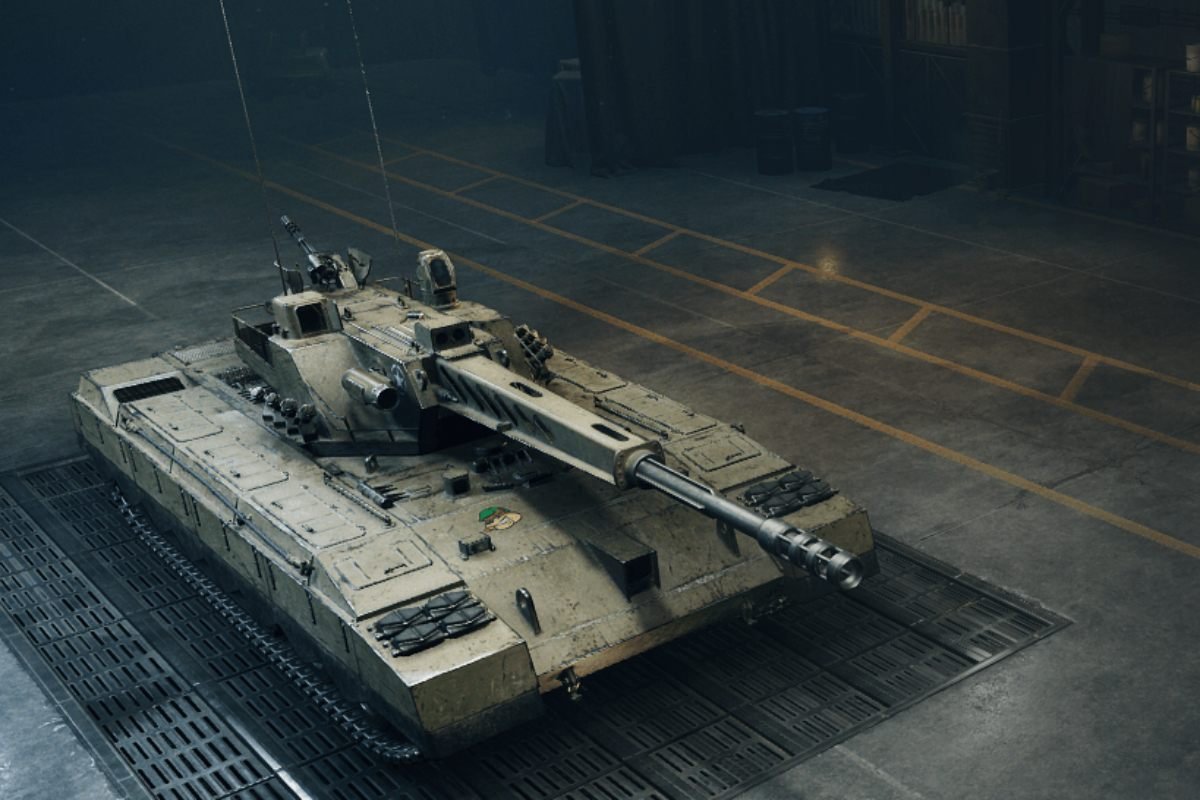
That mechanic immediately created one of the most divisive reactions the game has seen in years.
Why the Ares Line Divided the World of Tanks Community
Some players viewed The Ares Line: U.S. Autocannon Mediums as one of the strongest medium branches Wargaming had ever introduced. Clips started spreading across Reddit, Discord, and YouTube showing lightly armored tanks getting erased before they could even reach cover. Mediums caught crossing open terrain were losing massive chunks of HP in seconds. In close-range fights, the Ares vehicles often felt less like classic mediums and more like pressure weapons designed specifically to punish hesitation.
Other players had the exact opposite reaction.
Critics argued the line was massively overhyped. At long range, the autocannon bloom and heat penalties made the tanks feel inconsistent. Some players hated how quickly the gun lost precision once heat climbed. Others complained that the mechanic encouraged reckless close-range gameplay instead of rewarding classic medium fundamentals like positioning, vision control, and precision peeking.
And honestly, both sides had a point.
The original version of the line was incredibly good at one specific thing: converting tiny mistakes into overwhelming punishment. That alone made the branch feel oppressive, especially in chaotic random battles where exposure discipline is already inconsistent.
Then Update 2.2 arrived and completely changed the conversation around the branch.
Instead of removing the autocannon concept or redesigning the vehicles entirely, Wargaming took a far more targeted approach. The company clearly wanted to preserve the identity of the line while toning down the parts players found frustrating to fight against. Damage output was reduced. HE effectiveness was weakened. Internal module damage was dramatically lowered. Cooling delays became slightly harsher. Armor reliability was trimmed in key areas.
The result is interesting because the Ares line still feels dangerous — sometimes extremely dangerous — but no longer feels quite as absurdly forgiving as it did during the first weeks after release.
That distinction matters.
Before Update 2.2, the branch often rewarded brute-force aggression. After the changes, the tanks still reward aggression, but only when the timing is clean. Players who panic-fire, overcommit, or waste heat carelessly now get punished far harder than before.
In many ways, the Ares line has become a better representation of what Wargaming probably intended from the start: a high-pressure medium branch built around tempo control and restraint, not simply nonstop damage spam.
TL;DR: The Most Important Changes
- The Ares line is still strong, but no longer feels as overwhelming during close-range engagements.
- The biggest hidden nerf was module damage reduction. Fires, ammo rack damage, and constant crits happen far less often now.
- HE shells were hit hard. Lightly armored tanks survive bursts more often than before.
- The Ares 90 C remains the biggest balance concern because it still combines survivability, pressure, and sustained damage too effectively.
- The branch now rewards discipline more heavily. Heat management and firing restraint matter much more after Update 2.2.
Why the Ares Line Became So Controversial
The original strength of the Ares branch was never just “high damage.” Plenty of tanks in World of Tanks can produce terrifying DPM numbers inside a garage stat screen. That alone does not automatically create balance drama.
The real issue was how efficiently the Ares tanks converted small positioning mistakes into massive punishment during live battles.
A medium crossing open ground for two seconds too long could suddenly lose half its HP. A retreating low-health vehicle often died before reaching cover. Even heavily armored tanks risked losing engines, ammo racks, or multiple internal modules during sustained bursts.
That is what made the branch feel oppressive to many players. The autocannon compressed punishment into extremely short exposure windows.
And because the mechanic never behaved like a traditional magazine system, opponents often struggled to predict exactly when the Ares tank was truly vulnerable. Against normal autoloaders, players understand the rhythm: survive the burst, then punish the reload. Against the Ares line, that rhythm became blurry because the gun technically never entered a “normal” reload cycle at all.
Instead, opponents were forced to think about heat buildup, cooling tempo, and lockout timing — mechanics that many players were still learning in real time.
That confusion added to the frustration.
What Update 2.2 Actually Nerfed
Update 2.2 targeted several important areas across the branch:
- Standard shell damage was reduced
- HE shell damage received heavier reductions
- Cooling delays were increased on higher-tier vehicles
- Internal module damage was dramatically lowered
- Armor values were adjusted on key turret and hull sections
At first glance, many players assumed the raw damage nerfs would be the defining change.
But after side-by-side gameplay testing, it quickly became obvious that not every nerf affected the branch equally. Some changes barely altered the gameplay loop at all. Others completely changed how frustrating the line felt to fight against.
The biggest surprise was honestly how fast Wargaming reacted.
The Ares line had barely settled into the live server meta before receiving major balancing adjustments. That alone says a lot about how aggressively the tanks were performing during their first weeks.
And among all four vehicles, the Ares 90 C immediately became the center of attention.
According to early performance tracking and community analysis, the tank rapidly challenged the Hacker for the highest average-damage Tier XI medium in the game. That raised immediate alarm bells because the Hacker was already considered one of the strongest vehicles at the tier.
After testing both versions side-by-side, it becomes much easier to understand why players reacted so aggressively to the branch in the first place.
The Hidden Nerf That Changed Battlefield Behavior
Ironically, the most important nerf was not the easiest one to notice inside the patch notes.
Most players immediately focused on alpha damage reductions and armor changes because those numbers are simple to understand. Lower damage equals weaker tank. Less armor equals easier penetrations.
But after extended gameplay testing, the biggest difference came from something else entirely: internal module damage reduction.
Before Update 2.2, the Ares tanks constantly crippled opponents during sustained fire. The autocannon did not simply shave HP bars. It repeatedly damaged critical components while doing it.
That meant fights against the branch often felt chaotic in the worst possible way.
Why the Original Ares Line Felt So Toxic
Before the nerf, the autocannon mechanic constantly disrupted enemy functionality during engagements.
Players regularly experienced:
- Engines caught fire constantly
- Ammo racks exploded or became damaged regularly
- Fuel tanks were repeatedly critted
- Tracks disappeared nonstop during sustained bursts
- Gun modules and crew members were constantly being damaged
Against lightly armored vehicles, the experience sometimes felt ridiculous. A player could survive the raw HP damage only to discover the tank was now on fire, missing crew members, and limping away with broken modules.
That is one reason the branch earned such a “toxic” reputation so quickly. The tanks were not simply dealing damage — they were removing functionality from enemy vehicles while applying pressure at the same time.
Side-by-side testing between the older version and the updated build showed a dramatic difference almost immediately.
On the pre-nerf version:
- Leopard 1 frequently ignited during bursts
- Maus regularly suffered multiple critical hits in one engagement
- Module destruction happened almost constantly during close-range pressure
After the update:
- Fires became far less common
- Ammo rack damage dropped sharply
- Module crits still happened, but no longer felt nonstop
- The branch felt noticeably less oppressive during sustained engagements
Honestly, this was probably the healthiest nerf Wargaming could have made.
The Ares line still retains its identity as a pressure-heavy medium branch, but it no longer feels like every burst automatically cripples half the internal systems inside an enemy vehicle.
That single adjustment improved the gameplay experience for both sides of the fight without completely destroying the autocannon concept itself.
The HE Nerf Changed Close-Range Combat More Than Expected
The HE reduction also had a much larger battlefield impact than many players initially predicted.
Before the nerf, lightly armored vehicles could disappear alarmingly fast if an Ares tank fully committed to a burst. Tank destroyers with weak armor profiles were especially vulnerable.
Vehicles like the Foch 155 sometimes died before they could realistically disengage once an Ares player got close enough to maintain sustained exposure.
That created some genuinely absurd combat moments.
A lightly armored vehicle could peek for what felt like a normal engagement window and suddenly lose enormous amounts of HP before the player even had time to process what happened.
After the HE reduction, those same vehicles now survive far more often.
And that survival matters because the Ares mechanic revolves heavily around timing. If the target survives long enough for the autocannon to overheat or cool inefficiently, the fight suddenly becomes much more manageable for the defending player.
That one change dramatically slowed the pace of certain close-range engagements.
The branch still punishes mistakes aggressively, but it no longer feels like lightly armored tanks are instantly vaporized the second they make one positioning error.
This matters even more at Tier XI, where exposure windows are already brutally short and burst damage scales much harder than at lower tiers.
The Cooling Delay Nerf Looks Scarier Than It Really Is
One of the more misunderstood adjustments was the increased cooling delay.
For several vehicles in the branch, cooling now starts slightly later after firing. Reading the patch notes makes the nerf sound devastating at first glance.
But in practice, the impact depends entirely on how the tank is being played.
The change mostly hurts players who rely on constant “single-tap” follow-up shots after a burst.
For example:
- An enemy survives with low HP after an aggressive firing sequence
- The Ares player tries to finish the target using repeated single shots
- Each shot now delays cooling slightly longer than before
Over several follow-up shots, that extra delay starts adding up.
However, experienced players quickly adapted by slightly changing their firing rhythm. Instead of repeatedly tapping individual shots, many now wait slightly longer for cooling stabilization before committing to another controlled mini-burst.
That distinction is important because it shows the branch was not mechanically destroyed.
Instead, the skill requirement increased.
The autocannon now punishes impatient firing sequences harder than before, which honestly fits the entire identity of the line.
The branch was always supposed to reward timing and restraint. Update 2.2 simply forced players to respect those mechanics more seriously.
The Armor Nerfs Matter — But Less Than Many Players Expected
The armor adjustments on the Ares 90 C definitely reduced survivability in several important areas.
Key armor sections dropped from:
- 273 mm down to 260 mm
- 241 mm down to 229 mm
The upper hull also became easier to penetrate using standard ammunition.
On paper, those are meaningful reductions.
But during actual gameplay, the armor nerfs often feel less important than the HE and module damage changes.
There are several reasons for that.
First, the turret profile remains relatively compact for a vehicle capable of sustaining that level of pressure. Second, the mantlet still absorbs an annoying number of shots for zero damage. Third, reserve tracks continue to improve survivability during disengagements and resets.
And perhaps most importantly, the Ares 90 C still combines mobility with pressure extremely effectively.
That combination allows the tank to dictate engagement tempo in ways many traditional high-DPM mediums cannot.
So while the armor nerfs absolutely reduced some of the vehicle’s forgiveness, they did not fundamentally change how the tank behaves during real matches.
The branch still survives long enough to create pressure repeatedly — and that is ultimately what makes it dangerous.
Why the Ares 90 C Still Feels Oppressive
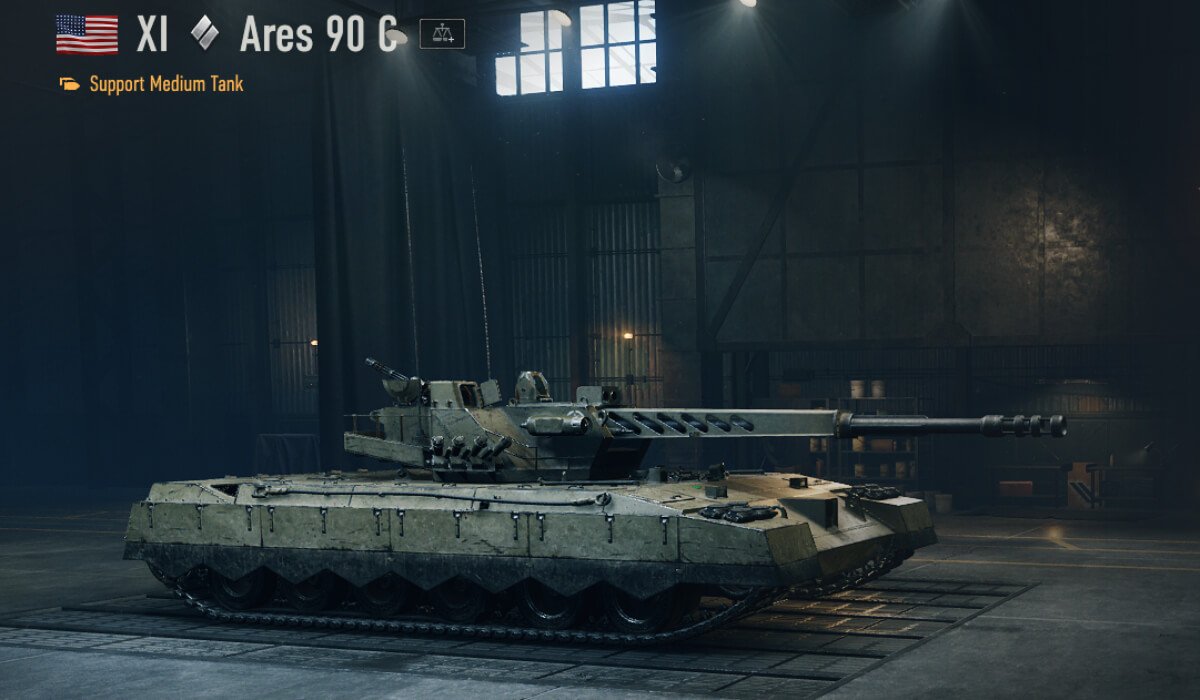
Even after multiple nerfs, the Ares 90 C remains the most controversial vehicle in the branch — and honestly, probably the most controversial medium tank currently sitting at Tier XI.
The reason is not one broken statistic.
The problem is how many strong characteristics exist inside the same package.
The tank still combines:
- Very high sustained pressure
- Strong effective DPM during real engagements
- Good mobility for a pressure-heavy medium
- Reserve tracks for safer disengagements
- A large HP pool
- Enough armor reliability to survive aggressive timing windows
Most high-DPM vehicles in World of Tanks struggle with one important issue: actually applying their theoretical damage during live battles.
Paper DPM means nothing if a tank cannot stay exposed safely enough to use it.
The Ares 90 C largely avoids that problem.
The autocannon mechanic allows the vehicle to maintain pressure in a way that feels fundamentally different from traditional burst mediums or classic autoloaders.
A skilled player can:
- Dump an aggressive opening burst
- Break line-of-sight briefly
- Cool just enough to stabilize performance
- Return seconds later with another dangerous firing sequence
That loop is what makes the tank feel exhausting to fight against.
Even after the nerfs, opponents rarely feel fully “safe” against it because the downtime windows are shorter and less predictable than traditional magazine systems.
The branch no longer instantly deletes everything the way it sometimes did at launch, but it still controls the pace of close-range engagements extremely well once momentum starts building.
The Real Problem With Fighting the Ares Line
The frustration surrounding the Ares branch is not purely about raw damage numbers.
Plenty of tanks can hit hard.
The real issue is how efficiently the line transforms tiny mistakes into catastrophic punishment.
A lightly armored medium crossing carelessly for one extra second can suddenly lose enormous amounts of HP. A tank destroyer that slightly over-peeks a corner may get trapped under sustained fire pressure before it can escape. A retreating vehicle with low HP often dies because the autocannon never gives it time to reset the engagement.
That is why the line earned the “toxic” label from parts of the community.
The tanks compress punishment into tiny windows where the defending player feels like there was almost no time to react.
And even after the nerfs, that core identity remains intact.
The branch is healthier now, but it is still one of the most aggressive punishment-based medium lines in the game.
How the Ares Line Actually Wants to Be Played
The biggest mistake many players make is trying to force the Ares tanks into traditional American medium gameplay.
They are not classic ridge-sniping support mediums.
They are not long-range precision farming platforms.
And they absolutely are not designed for passive gameplay.
The branch works best when played as a tempo-pressure medium line.
That means constantly managing engagement flow rather than simply maximizing raw damage numbers.
The ideal gameplay loop usually looks like this:
- Open fights from mid-range using short controlled bursts instead of overheating immediately
- Identify isolated or exposed targets before committing heavily
- Spend heat aggressively only when the trade is favorable
- Disengage before the lockout becomes dangerous
- Re-enter from another angle after stabilizing heat
The strongest Ares players are usually not the players holding the trigger nonstop.
They are the players controlling the rhythm of the engagement.
That distinction becomes even more important after Update 2.2 because the branch now punishes wasted heat much harder than before.
Before the nerfs, reckless aggression could still produce strong results simply because the raw punishment numbers were so high.
Now, bad bursts feel expensive.
Heat wasted into armor, missed shots, or low-value targets often creates self-inflicted downtime that stronger opponents immediately punish.
The Ares Line Rewards Discipline More Than Aggression Now
One of the biggest post-2.2 changes is psychological rather than statistical.
The branch now rewards restraint more heavily than pure aggression.
That sounds strange for a line built around sustained fire pressure, but it becomes obvious after extended gameplay.
The best Ares players are usually patient during the early stages of a battle.
They:
- Watch reloads carefully
- Track isolated targets
- Wait for bad rotations
- Punish over-peeks
- Commit only when escape routes still exist
That is why the branch often feels terrifying in strong hands but mediocre in average hands.
The mechanic punishes emotional decision-making extremely hard.
Panic firing creates overheating. Overheating creates downtime. Downtime inside close-range fights usually creates disaster.
In many ways, the Ares line behaves less like a traditional medium branch and more like a stamina-management system attached to a tank.
The gun is strongest when heat is spent carefully for decisive outcomes — not when the trigger is held simply because it can be.
How to Counter the Ares Line Properly
Fighting the Ares branch successfully requires understanding what the tanks actually want from an engagement.
The autocannon thrives on sustained exposure and tempo control.
So the best counterplay revolves around denying both.
- Keep exposure windows short. The longer the Ares tank maintains line-of-sight, the more dangerous it becomes.
- Force longer-range engagements whenever possible. The branch is far less comfortable during slow precision fights.
- Bait overheating. Many players still panic-fire when they smell a kill opportunity.
- Punish resets and cooldown moments. The best time to attack an Ares tank is often immediately after it commits aggressively.
- Avoid greedy retreats on low HP. The autocannon excels at finishing damaged vehicles before they escape.
The line feels most oppressive when opponents feed it momentum.
Once the pace of the engagement slows down, the tanks become far easier to manage.
Is the Grind Still Worth It After Update 2.2?
For players who enjoy active medium gameplay, the answer is still yes.
The Ares branch remains one of the most mechanically unique medium lines currently available in World of Tanks. Even after the nerfs, nothing else in the game really plays quite the same way.
But the line is no longer a low-effort damage machine.
Players who mismanage heat, overcommit constantly, or try to brute-force every engagement will struggle much more after Update 2.2.
The branch now rewards:
- Patience
- Positioning
- Target selection
- Map awareness
- Controlled aggression
In other words, the line finally behaves more like a true high-skill medium branch instead of a raw chaos generator.
That probably makes the game healthier overall — even if some players miss the ridiculous launch version.
Conclusion
The Ares Line: U.S. Autocannon Mediums survived Update 2.2 without losing its core identity.
The branch still punishes mistakes aggressively. It still dominates careless exposure. And it still feels completely different from traditional medium tank gameplay.
But the easy-mode version of the line is mostly gone.
Reduced module damage, weaker HE performance, stricter cooling behavior, and lower survivability pushed the branch closer to what it probably should have been from the start: a high-pressure medium line built around timing, restraint, and tempo management rather than nonstop chaos. The Ares tanks remain dangerous — especially in skilled hands — but now they demand cleaner execution to reach the same results.
For players looking for a traditional American medium experience, the line may still feel awkward or even frustrating. The line no longer wins fights simply because the trigger is held down. Now it wins when the player understands timing.
For players who enjoy aggressive timing windows, pressure-based gameplay, and mechanics that reward discipline under stress, the Ares branch remains one of the most interesting grinds currently available in World of Tanks.

